Sunday, September 15, 2013


Saturday, September 14, 2013
WCOG Meeting for September
Really light turnout today.
I finally had a chance to fold Jeremy Shafer's Super Boomerang and Boomerang airplane.
Pam Miike filmed this (so "blame" her for the timing on the slo-mo button on my Casio high speed Exilim EX-FC 150). The reason why I'm kneeling is because the boomerang kept hitting the low ceiling.
Shafer makes it look so easy; I was hoping that you could throw it any which way, and they'd still come back to you. The reality is, like my glider, it takes practice to get a feel for throwing them.
Tutorials:
I finally had a chance to fold Jeremy Shafer's Super Boomerang and Boomerang airplane.
Pam Miike filmed this (so "blame" her for the timing on the slo-mo button on my Casio high speed Exilim EX-FC 150). The reason why I'm kneeling is because the boomerang kept hitting the low ceiling.
Shafer makes it look so easy; I was hoping that you could throw it any which way, and they'd still come back to you. The reality is, like my glider, it takes practice to get a feel for throwing them.
Tutorials:
Not a Kawasaki from a Dollar
New model uploaded by Jeremy Shafer:
Turn an ordinary one dollar bill into a lovely rose! (Designed by Jeremy Shafer) This model can be folded from a dollar as I show in the video, but it's actually even better folded from a 1X2 rectangle, that way you can skip folding in the edges (see 1:00 and 1:20). The $5 Euro banknote is 62 X 120 which is reasonably close to 1 X 2. If your country's currency is shorter than 1X2 then you will need to fold the long edges in a little bit in order to obtain a 1X2 rectangle. Of course, money folding is only really popular in the U.S., right???
Friday, September 13, 2013
The Crane and the Hedge Sparrow
By Paul Hanson published on the BOS YouTube Channel:
A paper crane and a Hedge Sparrow (Dunnock) are separated by a barrier. However the bird is determined to meet its pleated friend, but what will finally make it give up?
Sunday, September 08, 2013
Extra Commercial
Warning: This might tug on your heartstrings:
Doesn't it just move you to want to go out and buy some Extra gum right now and start chewing? [/Sarcasm]
...Or at the least, start folding some wrappers?
Some of theYouTube comments are pretty funny.
Hat tip: Chris Lott on the O-List
Doesn't it just move you to want to go out and buy some Extra gum right now and start chewing? [/Sarcasm]
...Or at the least, start folding some wrappers?
Some of theYouTube comments are pretty funny.
Hat tip: Chris Lott on the O-List

Thursday, September 05, 2013
September NOA #457


Diagrams:
Child Raccoon dog by Mr. Kunihiko KASAHARA
Envelope with a rabbit by Ms. Ayako KAWATE
Rabbit by Mr. Ryo AOKI
Kangaroo by Mr. Katsushi NOSHO
Flattering humming bird by Ms. Shoko AOYAGI
Mouse-shaped glove-puppet by Ms. Mariko MIYAMOTO
Dachshund-shaped chopsticks' wrapper by Mr. Katsuhisa YAMADA
Fence by Ms. Shoko AOYAGI
Flower of cosmos by Ms. Ayako KAWATE
Pentagonal box with a balloon flower by Mr. Hajime KOMYA (Original model by Ms. Tomoko FUSE)
Curler Units by Mr. Herman Van Goubergen
Consider subscribing to NOA.
*UPDATE*

Wednesday, September 04, 2013
Boon's Frog
 |
| Source |
Designed by Quentin Trollip, the paper given to him by Caveman Boon is perfect! It gives the feel of a rough textured hide, along with warts.
Monday, September 02, 2013
More puzzles and paperfolding fun at Marti's!
 |
| Alex helped Hisako on these- she LOVES turtles! |
Marti was out of country in Japan for a puzzle convention last month (International Puzzle Party?); so Alex Lam- Mr. Origami- did not get the grand tour of Marti's house at the August meeting (his first visit). This time, he did.
Marti had to ship her puzzles, which will be a while yet to arrive; and given that next month is PCOC, it probably won't be until November when we will be able to play with her new puzzles.
Alex, Hisako, Pam, and I frustrated ourselves over "after hours" puzzle-solving, staying another 2 hours past the end of the origami meeting.
Alex was pretty good at solving some of these things:
 |
| Alex holding two leftover pieces to a chocolate popsicle puzzle; eventually he figured out using all the pieces |
Sunday, September 01, 2013
Sunday Folding Funnies

Source:
Just a quick comic I thought up while folding my origami versions of the Mane Six.
Yes, that is Kamiya's Ryujin Apple Bloom folded. No, I have no idea how she managed to do that in a class period using only her hooves.
Wednesday, August 28, 2013
Tuesday, August 27, 2013
Remember the movie "Gremlins"?
Another charming design(s) by Fernando Gilgado:
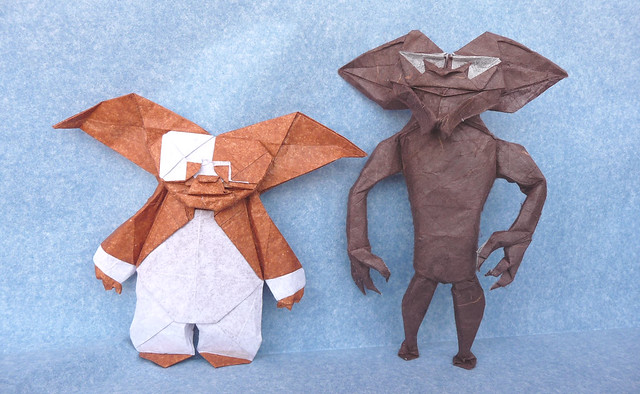
Mark Leonard's old site used to host diagrams for his Mogwai.
Sunday, August 25, 2013
Sunday Folding Funnies
Meet Ken Wong:
Since I often enjoy playing “devil’s advocate” in debates, I was among those who – although our very presence at that night’s reception made us obvious supporters of the webcomics movement - contrarily maintained there were still many things that print comics could do that webcomics could not. Our strongest argument in favor of printed comics was that they offered readers a physical/kinesthetic experience that webcomics could never duplicate; readers could bend, fold, tear or otherwise manipulate the comic in ways that are impossible to duplicate onscreen.At some point, it occurred to me that one could use origami, the Japanese art of paper folding, to create a comic in which the reader’s physical interaction with the comic as a tangible three-dimensional object was essential to the experience and, therefore, impossible to do as a webcomic.When I returned home, I decided to put theory into practice and the result was Pandora’s Box, a comic which readers must open and unfold (and, ideally, refold) as part of the reading experience. Crucially, the box is to be opened at precisely that point in the story when such an action is loaded with the greatest significance.I debuted Pandora's Box to a warm reception at the 2008 MoCCA Art Festival and have since gone on to create several other Origami Comics: Schrodinger's Cat; Flexagon!; 2d4; and Unsung.
Friday, August 23, 2013
Origami $ Piggy Bank
Love John Montroll's version. This one looks great, too:
The concept itself is a charming one.
The concept itself is a charming one.
Sunday, August 18, 2013

Wednesday, August 14, 2013
Origami's Future in Space Exploration
Hat tip to WCOG member, Helen Sperber:
A senior at South El Monte High School, and founder of its Engineering Club, Hua, 17, landed a coveted high school summer internship at JPL alongside about eight other high school students, where he joined the research of the deployment of solar arrays that utilize the basic principles of origami — a Japanese art form that creates flashy designs like birds, flowers and cartoon characters by folding a piece of paper.
“The way it folds up is very unique compared to other arrays where it’s just a square piece that folds up,” he said. “So there’s definitely some art in there.”
~~~
“They’re very aesthetic in their appearance in the way they fold, much like other origami,” said Brian Trease, a mechanical engineer at JPL and Hua’s mentor during his internship. “We cut it into pieces and reassembled in a certain way. Origami has ways. We’re allowed to break the rules for engineering purposes.”
The origami-inspired solar arrays use a rigid structure to safely fold into itself, keeping the array’s 90 individual solar cells sturdy.
“Fragile things like solar cells, which could just break when they’re bent, would be perfect for this solar array,” Hua said.
He said the design could also be applied in other applications.
Shrinking instruments to make for more room is a goal for current and future space exploration, according to Randall Foehner, a JPL mechanical engineer and the group supervisor of Hua’s internship group, division 38, which focused on mechanical deployables, actuators and booms.
“We’re trying to do more science with less spacecraft, so we’re miniaturizing everything,” Foehner said. “This technology, folding and storing in small volumes, is in perfect alignment with the future of a spacecraft and what we’re trying to do.”
Tuesday, August 13, 2013

Sunday, August 11, 2013

Subscribe to:
Posts (Atom)